Match Overview: A Week 17 Thriller at Levi’s Stadium
The Week 17 clash between the Chicago Bears and the San Francisco 49ers delivered one of the most electrifying games of the 2025 NFL season. Played on December 28, 2025, at Levi’s Stadium, the matchup ended with a narrow 42–38 victory for San Francisco in a contest that felt like a playoff game from the opening snap.
Both teams entered the game with postseason implications still alive, and that urgency showed in the intensity, pace, and offensive creativity on display. Rather than a defensive struggle, fans witnessed a full-scale offensive duel where explosive plays, quick scoring drives, and aggressive fourth-down decisions defined the tone.
What made this matchup especially compelling was the balance of styles. Chicago leaned heavily on dynamic quarterback play and perimeter passing attacks, while San Francisco countered with a more balanced offensive structure built on rhythm passing, timing routes, and efficient red-zone execution. The result was a game that remained undecided until the final defensive stop.
First Half Breakdown: Fast Start and Immediate Response
The opening quarter set the tone for what would become a back-and-forth shootout. San Francisco struck first with a sharp, methodical drive that combined short completions and effective rushing attempts to move into scoring range. Their opening touchdown immediately signaled an intent to dictate tempo early.
Chicago responded quickly, refusing to fall into an early deficit mindset. Their quarterback led a high-tempo drive that stretched the field vertically, using sideline throws and intermediate crossing routes to attack defensive gaps. This quick answer prevented San Francisco from building early momentum.
By the end of the first quarter, both teams had already established their offensive identities: San Francisco focused on structured efficiency, while Chicago emphasized explosive passing and improvisation under pressure.
In the second quarter, the game shifted into a higher gear. San Francisco delivered the first major explosive play of the night—a deep touchdown pass that covered more than 40 yards and immediately energized the home crowd. Chicago responded once again, showing resilience with a red-zone scoring drive that kept the game tight.
At halftime, neither team had control. Instead, the game reflected statistical parity, with nearly equal yardage, similar time of possession, and minimal separation in execution.
Quarterback Performance: Elite-Level Duel Under Pressure
San Francisco’s quarterback delivered one of his most efficient performances of the season, throwing for over 300 yards with multiple touchdowns and no critical late-game mistakes. His ability to distribute the ball across multiple receivers prevented Chicago’s defense from keying on any single target. Quick reads, play-action timing, and smart pocket movement all contributed to his success.
On the other side, Chicago’s quarterback matched the intensity with a high-volume passing performance. He consistently attacked downfield, taking calculated risks that resulted in both explosive gains and critical scoring opportunities. His ability to extend plays outside the pocket added another layer of difficulty for the 49ers’ defense.
Both quarterbacks demonstrated strong completion efficiency on short and intermediate routes. These high-percentage throws allowed sustained drives and kept scoring pressure constant. The difference, however, came in late-game decision-making and red-zone conversion consistency, where San Francisco held a slight but decisive edge.
Passing Game Breakdown: Explosiveness vs Efficiency
The passing game became the centerpiece of this Week 17 showdown.
San Francisco’s aerial attack was defined by balance. Multiple receivers contributed meaningful yardage, preventing defensive concentration on one primary threat. Their longest completion of the night came on a perfectly timed deep route that shifted momentum instantly and led to a touchdown on the same drive.
Chicago, however, relied more heavily on explosive individual plays. Their passing attack frequently targeted tight windows downfield, resulting in several high-reward gains. One key sideline completion in the third quarter set up a crucial touchdown that briefly swung momentum in Chicago’s favor.
Red-zone performance ultimately became a key separator. San Francisco consistently converted drives into touchdowns, while Chicago occasionally settled for shorter gains or faced stalled possessions inside the 20-yard line. In a game decided by four points, these small differences proved decisive.
Rushing Game Analysis: Balanced but Underrated Impact
Although the game is remembered for its passing fireworks, the rushing attack played a critical supporting role for both teams.
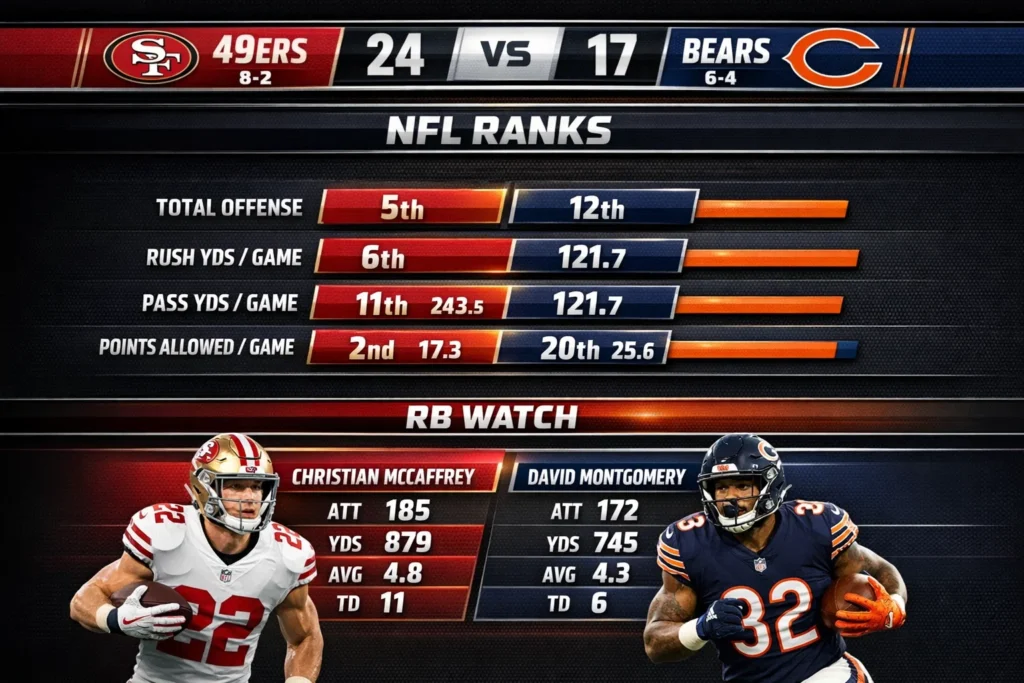
San Francisco finished with more than 120 rushing yards as a team, maintaining consistent production on early downs. Their lead running back averaged over four yards per carry, helping sustain balanced offensive sequencing. These gains kept defensive fronts honest and opened passing lanes for play-action opportunities.
Chicago also performed effectively on the ground, combining designed runs with quarterback scrambles to surpass the 100-yard mark. While not dominant, their rushing attack provided essential stability during long drives, particularly in the second half when game tempo increased.
Neither team fully controlled the line of scrimmage, but both used rushing strategically rather than as a primary weapon. This balance contributed to sustained offensive rhythm across all four quarters.
Receiving Performances: Depth and Explosive Playmaking
The receiving units for both teams played a crucial role in shaping the game’s identity.
San Francisco’s receivers demonstrated depth and versatility. Multiple pass-catchers recorded significant yardage, with several exceeding the 70-yard mark. Their ability to separate on timing routes and exploit defensive mismatches created consistent scoring opportunities.
Chicago’s receiving corps matched that production through physicality and contested catches. Their top receiver commanded double-digit targets, frequently converting difficult throws into first downs. Sideline awareness and strong hands were key factors in maintaining offensive momentum.
Touchdowns through the air defined the rhythm of the game. Both teams scored multiple receiving touchdowns, with precise red-zone execution and well-timed route combinations proving essential. The difference again came down to consistency, as San Francisco converted a slightly higher percentage of scoring opportunities.
Defensive Performance: Pressure Moments That Shaped the Outcome
Despite the high final score, defensive units still produced critical game-altering moments.
San Francisco’s defense generated multiple sacks that disrupted Chicago’s offensive rhythm at key moments. One forced fumble in the second half became a major turning point, directly leading to a scoring opportunity that shifted momentum permanently in favor of the home team.
Chicago’s defense showed flashes of strong resistance, particularly in pass coverage. A well-timed interception in the third quarter led to a quick scoring drive, briefly giving Chicago control of the game. However, sustaining pressure on San Francisco’s quarterback proved difficult.
Tackling efficiency remained solid on both sides, but neither defense could consistently prevent explosive plays. This allowed the game to evolve into a pure offensive shootout.
Special Teams Contribution
Special teams quietly played a stabilizing role throughout the contest. Both teams delivered solid return yardage, helping improve field position during key drives.
Chicago recorded a successful field goal attempt, while San Francisco opted for aggressive offensive execution in most scoring situations rather than relying on kicking. Punt and kick return units contributed moderate yardage but did not directly influence scoring outcomes.
While not the headline factor, special teams execution ensured that neither side was significantly disadvantaged in field position battles.
Fourth Quarter: Momentum Shifts and Final Drama
The fourth quarter transformed the game into a full-scale thriller.
Chicago briefly seized the lead with a well-structured touchdown drive that showcased precision passing and disciplined execution under pressure. At that moment, momentum appeared to shift toward the visiting team.
However, San Francisco responded like a seasoned contender. Their offense orchestrated a controlled, methodical drive that blended short passes with timely runs. This balanced approach allowed them to reclaim the lead late in the game.
Defensively, San Francisco delivered the most critical stop of the night with a key sack that forced Chicago into a difficult third-and-long situation. That defensive pressure effectively ended Chicago’s final comeback hopes.
With the clock winding down, San Francisco managed possession intelligently, eliminating any remaining opportunities for a late Chicago surge.
Advanced Statistical Takeaways
From an analytical perspective, several advanced metrics highlight why San Francisco prevailed:
San Francisco slightly outperformed Chicago in third-down conversion rate, extending more drives during critical moments. This ability to sustain possession proved essential in a game where every offensive series mattered.
Red-zone efficiency was the most important statistical difference. San Francisco consistently turned red-zone appearances into touchdowns, while Chicago experienced at least one stalled drive inside the 20-yard line.
Penalty discipline also played a subtle but important role. Chicago committed a key late-game penalty that extended a San Francisco drive, allowing valuable clock management that ultimately influenced the final outcome.
Historical Rivalry Context
The matchup added another chapter to the evolving history between these franchises. The San Francisco 49ers continue to hold the upper hand in the all-time series, strengthening their historical advantage with this victory.
Recent meetings between these teams have increasingly featured high-scoring, offense-heavy games, reflecting modern NFL trends and evolving offensive philosophies. This game further reinforced that pattern, showcasing elite quarterback play on both sides.
Player of the Game
The standout performer of the night was San Francisco’s quarterback, who delivered an elite-level performance under pressure. His combination of passing yardage, touchdown production, and late-game composure defined the outcome of the game.
On the defensive side, a San Francisco linebacker earned recognition for leading the team in tackles and forcing a critical turnover. His ability to read plays and disrupt Chicago’s offensive rhythm was instrumental in key moments.
What This Result Means Going Forward
For San Francisco, this victory significantly improved their positioning in the NFC playoff race. The win strengthened their seeding potential and reinforced their status as a postseason contender capable of winning high-pressure games.
For Chicago, the loss was competitive but revealing. While the offense demonstrated strong potential, defensive inconsistency and late-game execution gaps remain areas for improvement. Heading into Week 18, the focus will be on converting offensive production into complete-game wins.
Conclusion
This 42–38 showdown between the Chicago Bears and the San Francisco 49ers will be remembered as one of the most entertaining games of the 2025 NFL season.
Both teams showcased elite offensive capabilities, but San Francisco’s superior efficiency in key moments ultimately made the difference. In a game where yardage was nearly even and scoring came frequently, execution inside critical situations—especially the red zone and fourth quarter—decided the outcome.
It was not just a win for San Francisco; it was a statement about composure, balance, and late-game control in a high-pressure environment.
FAQs
What was the final score of Bears vs 49ers in Week 17, 2025?
The San Francisco 49ers defeated the Chicago Bears 42–38 in a high-scoring matchup.
Who had the better quarterback performance?
San Francisco’s quarterback slightly outperformed Chicago’s quarterback with over 300 passing yards and multiple touchdowns.
How many total yards were in the game?
Both teams combined for more than 900 total offensive yards.
What was the biggest turning point?
A second-half forced fumble and a key fourth-quarter defensive stop shifted momentum toward San Francisco.
Why did San Francisco win?
Superior red-zone efficiency, better late-game execution, and key defensive plays helped secure the victory.
Latest Blogs:
| Atompace Guide |